Highlighting Work from Our New NC Caregiving Research Network
The NC Caregiving Research Network brings together researchers and partners to connect and vision about amplifying existing research and expanding our collective work to improve the health and well-being of North Carolina’s caregivers across the life course.
In a webinar series to promote caregiving research, network members have been sharing their research to the broader community to build awareness and inspire action and change.
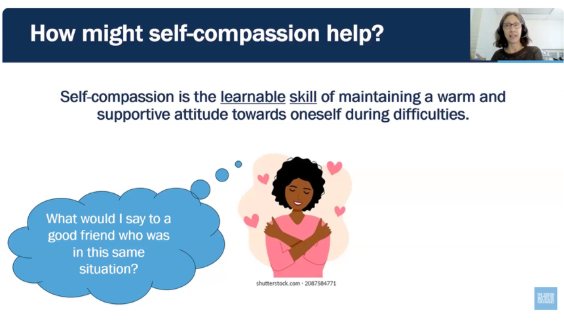
In this post, we highlight the research of Dr. Christine Lathern, MD, MSPH, Assistant Professor, Department of Physical Medicine and Rehabilitation, at UNC-Chapel Hill. Her talk was entitled “Self-Compassion-Based Resilience Habits Cours for Caregivers of Children with Physical Disabilities: A Pilot Study.” The conceptualization of self-compassion she studies and teaches originated from clinical psychologist and researcher Kristin Neff (2023).
Below, we share two clips from her talk followed by a brief Q and A.
“Self-compassion is the learnable skill of maintaining a warm and supportive attitude towards oneself during difficulties.”
Learn about course content here:
Read below for our conversation with Dr. Lathren.
JIF: What are your key tips for folks to build their self-compassion?
CL: Self-compassion is a mindset or a response pattern that takes practice. We often have well-worn patterns of how we handle difficult feelings and our inevitable human imperfections– and these patterns may be harsh and judgmental. And, many of us have or have had experiences within our families, jobs, and culture that encourage judgmental or unforgiving expectations of ourselves. For this reason, it can feel uncomfortable or even scary to practice self-compassion. So some tips are:
- Consider using resources available to learn about self-compassion (see below for programs, books, and free online guided practices). If you have both time and resources, courses are a great way to learn because they connect you with like-minded people who will support you and provide a structured learning environment with a trained facilitator. If you don’t have the capacity to take a course, reading and accessing free guided practices are a nice way to get familiar (see below).
- One small way to start practicing self-compassion is by noticing difficult, stressful or overwhelming moments, pausing, and saying to yourself: “This is hard. My feelings make sense given this situation. I’m doing my best.” (or another kind phrase that feels right for you in the moment– something you might say to a friend who was in a similar situation).
- Take it slow and be gentle with yourself, knowing that changing patterns can take time and there can be discomfort or resistance with trying a new way of thinking.
- Consider setting some visual reminders and/or set aside time in your day (could be just a few minutes at the start or end of the day) to practice.
- We tend to stick to practices that feel good. Taking the time to experiment with different practices and finding those that feel supportive (and leaving out the ones that don’t) is a very self-compassionate thing to do!
- Finally, and importantly, these tools and resources may not be appropriate for everyone. For example, learning self-compassion under the guidance of a mental health professional is likely best for folks with unprocessed trauma or PTSD, major depression or severe clinical anxiety, substance use disorder or active psychosis.
JIF: How can we demonstrate and advocate for this approach in our communities and workplaces?
CL: Such a good question! That is part of what my research entails– for example, how can families cultivate a culture of self-compassion?
A powerful way parents, caregivers, and teachers can encourage kids to use self-compassion is by modeling it. For example, parents can speak aloud about their mistakes and difficult feelings instead of hiding them or being self-deprecating. This helps kids learn that they are not alone in feeling difficult feelings or making mistakes– even grown-ups experience this.
Then, parents can describe aloud how they are handling the tough situation with care, encouraging self-talk, and taking wise, supportive action.
I think this is true in our communities and organizations too. For example, I believe we can make self-compassion a core value in the workplace by modeling it for our colleagues and for those we supervise. We can show that we can hold ourselves to high standards AND take care of ourselves simultaneously. Supervisors who are able to admit mistakes and imperfections, ask for help when needed, take care of their bodies, and set scheduled time aside for recovery and rejuvenation are sending a powerful message to their colleagues. Imagine a meeting where the leader says “I’m feeling a bit tense. I need a minute to pause and take a few breaths and stretch — please join me if you’d like!” (Might not work in every setting, but it could work in many!) We can also name self-compassion, along with compassion for others, as an explicit core value within our work teams.
Ultimately, helping dispel the notion that self-compassion is weak, lowering standards, lazy or selfish is important messaging for our communities to get buy-in. The new message is that self-compassion allows us to meet our goals sustainably. The message is that humans operate best in environments where they feel safe and supported, and that we have power to create our own supportive internal environments! That is great news!
JIF: What are some resources our community can check out?
CL: Here are some great resources:
- Many different course options and resources are available through the Center for Mindful Self-Compassion: https://centerformsc.org/
- Circles of Practice is a live, online, free public self-compassion offering daily: https://centerformsc.org/pages/circles-of-practice
- Resources from the creators of the mindful self-compassion programs: https://chrisgermer.com/; https://self-compassion.org/
- Websites for parents and kids: https://jamielynntatera.com/; https://kindmindacademy.com/the-booster-way
- Website for teens: https://karenbluth.com/
To learn about the NC Caregiving Research Network, visit our website for more information: https://jordaninstituteforfamilies.org/caregiving-initiative/
Citation
Neff, K. D. (2023). Self-compassion: Theory, method, research, and intervention. Annual review of psychology, 74(1), 193-218.