What is Cognitive Behavioral Therapy?
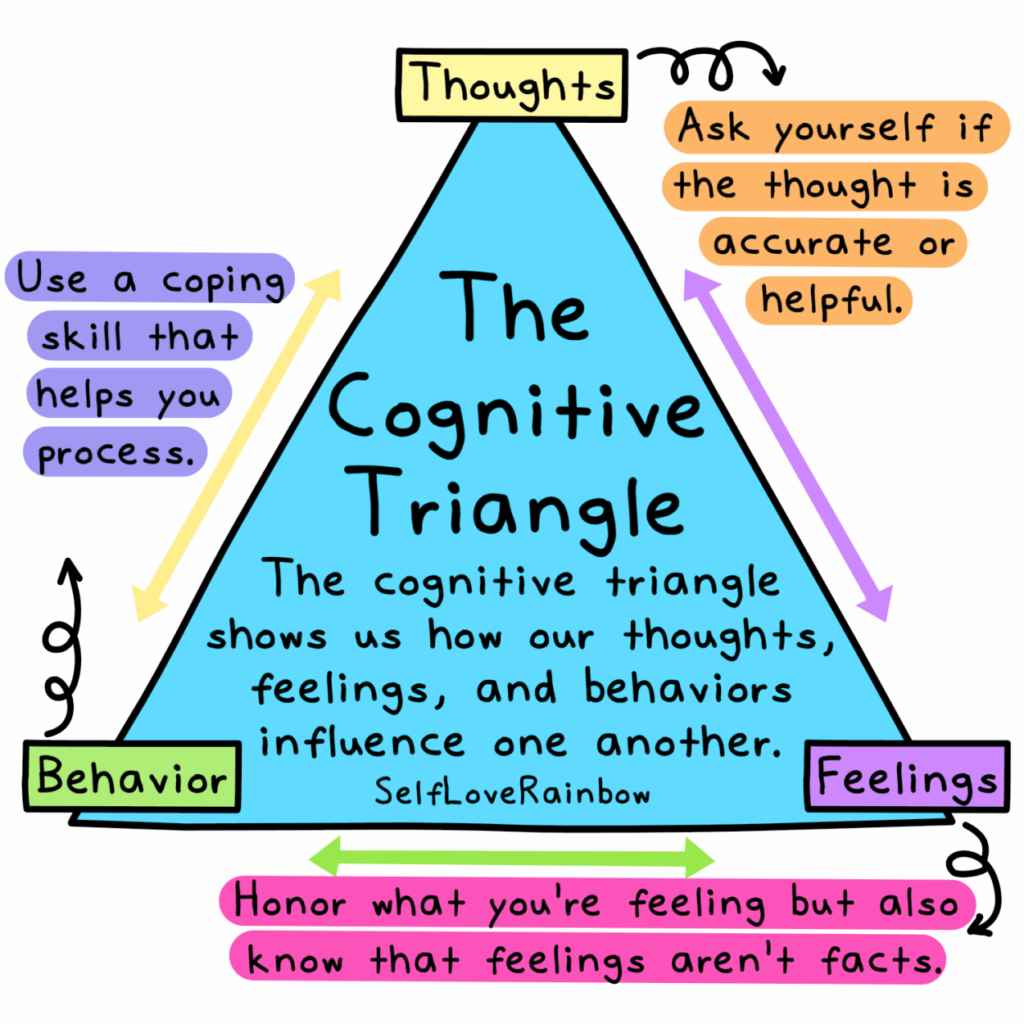
Cognitive Behavioral Therapy approaches are based on the idea that there is an influential cycle among thoughts, feelings, and behaviors. It was designed to help individuals with depression identify dysfunctional or unhelpful thought patterns and modify those thoughts to influence their mood and behaviors (Beck, 2021).
Where do these dysfunctional thoughts come from, and what do they look like? Typically, dysfunctional or distorted thoughts are subconscious and are heavily shaped by our core beliefs, which are ideas we hold about ourselves, other people, and the world (Beck, 2021). Examples of core beliefs include “I didn’t submit that report in time. I can never do anything right.” or “They walked by me without acknowledging me, so they must be angry with me!”
Now, why would CBT be beneficial in the workplace? I’m leading my team, not providing therapy!
Incorporating evidence-based strategies from cognitive-behavioral theory can benefit leaders by providing accessible methods for managing stress, improving communication, enhancing decision-making, and supporting employees more effectively. By engaging in self-awareness and reflection of automatic thoughts, supervisors can remain calm and focused in challenging or stressful situations. One effective cognitive-behavioral technique is the ABC model, which involves reflecting on the Activating event (A), Personal beliefs (B), and Consequences (C) in a given situation, and considering how to reframe the experience (Zusman et al., 2025). The Activating event (A) refers to a specific occurrence that triggers a reaction. For example, an employee submits another late case note despite being reminded earlier in the week. Personal beliefs (B) are the automatic thoughts that arise from this activating event. In this case, the supervisor might think, “They are lazy and don’t care about this job,” which can lead to feelings of frustration and judgment. The resulting Consequences (C) may include the supervisor feeling angry, writing a blunt email to the employee, or delegating all responsibilities to other staff members rather than to this individual.
Applying the ABC model can allow leaders to step back and examine their personal beliefs stemming from the activating event. For instance, when an employee submits a case note late, a supervisor might initially perceive the employee as lazy. However, the supervisor should take a moment to reflect on this belief by asking questions such as, “What evidence do I have for this belief? What else could be contributing to the late submission?”. By doing so, the supervisor can reframe their beliefs and approach the situation with curiosity and empathy. They could ask the employee, “I’ve noticed some reports are late. Can we discuss any challenges you’re facing?”. Increasing awareness of negative or unhelpful automatic thoughts helps supervisors improve their emotional regulation and empathy, ultimately fostering psychological safety in the workplace. With practice, supervisors can become better equipped to manage their thoughts in crisis or high-stakes situations and develop practical problem-solving skills.
Many individuals who have achieved leadership positions often experience some form of imposter syndrome or self-doubt. While these feelings can drive us to become more effective leaders, they can also hinder our embrace of courageous leadership. One significant tool to address these anxieties is cognitive restructuring, which helps increase self-esteem by modifying negative self-beliefs (Zusman et al., 2025). For example, we can reframe this automatic thought, “I let my team down. I don’t have what it takes to be a leader.”, to a more constructive perspective: “I made a mistake that affected my team, but that doesn’t mean I’m not capable of leading. Every leader faces setbacks, and this is an opportunity for me to learn and improve my approach.” A leader’s mindset shapes the leadership styles they use. When leaders engage in positive self-evaluation and view their environment and people as safe and supportive, they are more likely to practice active and transformational leadership (Dóci et al., 2015).
Cognitive behavioral techniques are valuable not only for enhancing leadership skills but also for employees. Supervisors can model these techniques to encourage constructive and reflective mindsets in the workplace. Role-playing scenarios with employees can improve interpersonal skills, while reframing negative thoughts and emotional responses can help to reduce burnout (Zusman et al., 2025). Additionally, it is important to consistently recognize and reward the positive behaviors of your employees to promote long-lasting motivation and team morale, ultimately leading to increased productivity and a more cohesive work environment.
Citations
Beck, J. S. (2021). Cognitive behavior therapy: Basics and beyond (3rd ed.). The Guilford Press.
Dóci, E., Stouten, J., & Hofmans, J. (2015). The cognitive-behavioral system of leadership: Cognitive antecedents of active and passive leadership behaviors. Frontiers in Psychology, 6. https://doi.org/10.3389/fpsyg.2015.01344
Zusman, N., Andrews, C. S., Kaslin, V., & Kienski Woloski Wruble, A. C. (2025). Creating a supportive work environment: A cognitive behavioral approach for nurse leaders. Nursing Reports, 15(3), 91. https://doi.org/10.3390/nursrep15030091