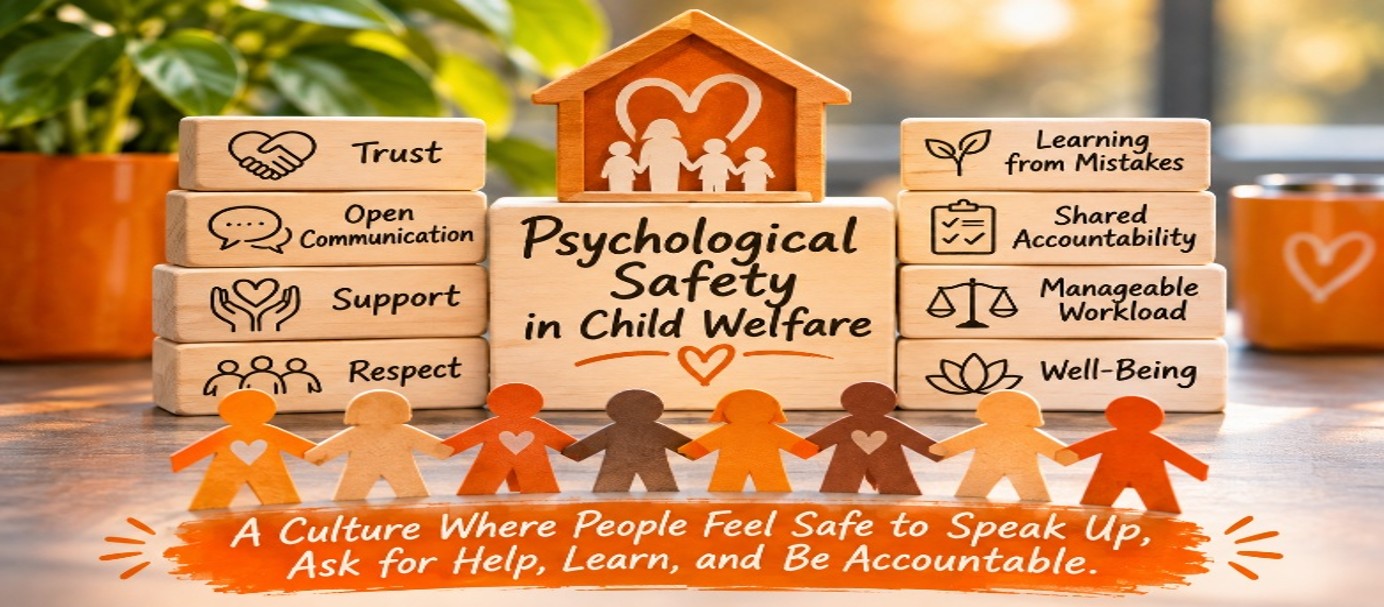
Creating a culture where employees feel safe to speak up, seek support, and learn from mistakes without compromising accountability or child safety.
When the People Responsible for Safety Don’t Feel Safe
Child welfare professionals are entrusted with one of society’s most significant responsibilities: protecting children, strengthening families, and making decisions that can profoundly impact the lives of those we serve. We expect these professionals to demonstrate compassion, exercise sound judgment, navigate complex situations, and remain accountable for their decisions, often while managing overwhelming caseloads, limited resources, and competing demands.
But there is a question I believe deserves greater attention: How can we expect child welfare professionals to create safety for children and families when they do not consistently experience psychological safety within their own organizations?
Over the past decade, I’ve experienced child welfare from three perspectives: as a frontline social worker, a supervisor, and now an interim program administrator. Each role has changed how I understand accountability, but not the responsibility we share to children and families.
What Is Psychological Safety, and Why Does It Matter?
Psychological safety is the shared belief that a team is safe for interpersonal risk-taking (Edmondson, 1999). Employees can ask questions, acknowledge mistakes, and disagree respectfully without fear of humiliation or punishment.
In a study of 51 work teams, Edmondson linked psychological safety with learning behaviors such as sharing information and discussing problems openly.
That matters in child welfare, where decisions about safety, family preservation, and permanency often involve uncertainty and complex requirements. Asking for guidance is part of responsible practice, not a sign of weakness.
A psychologically safe workplace is not one where employees are expected to know everything. It is one where they feel supported in recognizing what they do not know and seeking the guidance necessary to make informed decisions.
Psychological Safety Is Not the Absence of Accountability
Psychological safety is sometimes mistaken for avoiding difficult conversations or lowering standards. LaPlante and Ponte (2026) argue instead that it requires honest feedback, constructive disagreement, and accountability. They emphasize that psychological safety does not mean tolerating poor performance or avoiding constructive disagreement. Rather, it requires leaders to promote honesty, transparency, learning, and accountability while creating environments where employees feel comfortable raising concerns.
At the heart of our responsibilities is the safety, well-being, and permanency of vulnerable children and families. Timely documentation, thorough assessments, court orders, and legal mandates are safeguards, not just paperwork. Meeting them also requires adequate staffing, manageable workloads, and organizational support.
A fear-based response may focus only on what was missed. A psychologically safe supervisor still addresses the requirement, but asks what contributed to the delay and what needs to change.
Was the worker responding to emergencies? Were expectations clear? Would training, assistance, or a different prioritization plan help? These questions inform accountability; they do not replace it.
The difference is that accountability should focus on strengthening professional practice rather than instilling fear.
The Connection Between Psychological Safety and Employee Retention
Kruzich et al. (2014) studied 1,040 public child welfare workers in 239 supervisory units. They found that supportive leadership and organizational attention to employees were associated with psychological safety, which in turn was associated with greater intention to remain employed.
For child welfare agencies, turnover can disrupt relationships with children and families and add pressure to already stretched teams. The study measured intentions rather than actual departures, but its findings make the quality of everyday supervisory relationships difficult to ignore.
What I find especially compelling is that psychological safety varied significantly among work groups within the same office (Kruzich et al., 2014).
This suggests that organizational culture is not experienced uniformly. Two employees working within the same agency may have very different experiences depending on their supervisory relationships and team environments.
When Individual Accountability Meets Systemic Barriers
Child welfare social workers are often left feeling that they must carry the weight of systemic barriers on their own shoulders.
We know why statutory obligations, federal and state mandates, county policies, court orders, and ethical standards matter: children and families depend on us to meet them. But what happens when the workload exceeds what one person can reasonably accomplish?
A worker may be juggling emergencies, court preparation, visits, family engagement, services, and documentation, all while trying to give each child individualized attention.
One of the hardest things I’ve witnessed is dedicated social workers knowing exactly what needs to be done while recognizing there simply aren’t enough hours to do it all. I remember that feeling myself, trying to balance court hearings, visits, documentation, family engagement, and unexpected emergencies while carrying a caseload above recommended standards. We understand what’s at stake for children and families, but dedication alone cannot overcome systemic barriers.
When work falls behind, employees may absorb the failure as their own. Staffing shortages and competing demands can start to feel like evidence of personal incompetence rather than conditions that require an organizational response.
If saying ‘I’m overwhelmed’ is treated as poor time management, or asking for help as incompetence, workers may stop speaking honestly about risks and unfinished work.
Social workers are responsible for prioritizing, communicating concerns, seeking guidance, and meeting professional obligations. They cannot, on their own, resolve vacancies or create more hours in the day. Supervisors and administrators share responsibility for responding to those conditions.
To me, psychological safety means being able to name these realities without shame, identify urgent safety priorities, and work together on realistic support and solutions.
Recognizing systemic barriers is only a beginning. Leaders must respond with resources, clear priorities, and a willingness to examine the conditions that shape employees’ work.
We cannot continue asking child welfare professionals to carry the weight of systemic barriers alone and then measure their success solely by whether they managed to overcome them.
What Psychological Safety Should Actually Look Like
An open-door policy is not enough. Psychological safety shows up in what leaders do when someone raises an uncomfortable concern or admits a mistake.
Drawing on LaPlante and Ponte (2026), I see six practices that matter in child welfare:
1. Employees can speak up without fear of retaliation.
Invite respectful questions and disagreements about case decisions, workload, and policy without treating them as disloyalty.
2. Leaders approach mistakes with accountability and curiosity.
Address immediate safety concerns and individual decisions while also examining training gaps, staffing, and workflow problems.
3. Supervision includes support, not just compliance monitoring.
Make room for reflective practice, problem-solving, and employee well-being alongside compliance monitoring.
When I became a supervisor, I understood the tension differently. I had to address missed requirements and performance concerns, but I also remembered what it felt like to be the worker managing those demands. I wanted honest conversations about performance to lead to growth, not become judgments about a person’s dedication.
4. Employees are invited to participate in decisions that affect their work.
Ask frontline staff what is working, what is not, and how changes will affect their work.
5. Leadership demonstrates humility and openness to feedback.
Acknowledge mistakes, reconsider decisions, and receive feedback without defensiveness.
6. Recognition extends beyond productivity.
Notice compassion, teamwork, and good judgment-not only completed tasks and outcome statistics.
Trauma-Informed Leadership Is an Organizational Responsibility
Child welfare teaches us to consider how trauma, chronic stress, and environment affect children and families. We should bring that same curiosity to how we understand our child welfare workforce.
When a worker is overwhelmed or hesitant to speak up, do we ask what conditions are contributing-or assume the problem is motivation or competence?
Trauma-informed leadership is not an excuse for poor performance. It is a commitment to understand the context of performance and respond fairly.
Supportive supervision cannot solve excessive caseloads or understaffing by itself. But it can help workers raise those concerns early, before they become crises.
Kruzich et al. (2014) highlight the importance of the supervisory work group; LaPlante and Ponte (2026) describe psychological safety as a leadership skill that takes consistent practice. Both reinforce a lesson I keep learning: our responses to our workforce matter.
An employee notices how we react when they bring a concern, admit a mistake, disagree, or say they need help. Those moments shape whether they will speak up the next time.
Agencies also need to examine personnel practices, performance systems, and administrative decisions. A worker may trust a direct supervisor but still fear consequences elsewhere in the organization.
Now, as I move into administration, I see the pressures on supervisors and agency leaders more clearly. That perspective makes me more conscious of our responsibility to listen when staff identify barriers, advocate for solutions, and consider how our decisions affect frontline practice.
The Kind of Child Welfare Culture I Want to Help Create
As I grow as a leader, I want people to seek help before a problem becomes a crisis, challenge decisions respectfully, and receive candid feedback without feeling diminished.
I want employees to know their worth is not measured only by documentation statistics or how much work they can carry.
Psychological safety is not established through a single training, employee appreciation initiative, or organizational statement.
It is developed through everyday interactions, especially when circumstances are difficult.
It is reflected in whether employees feel comfortable saying, “I made a mistake.”
It is reflected in whether someone can respectfully say, “I disagree.”
It is reflected in whether employees can acknowledge, “I need help,” without fearing that their honesty will be used against them.
And perhaps most importantly, it is reflected in whether leaders are willing to examine their own practices with the same level of accountability they expect from others.
The true measure of psychological safety is not whether employees feel comfortable speaking up when things are going well, but how leadership responds when they speak up about something that has gone wrong.
Protecting children, strengthening families, and achieving permanency require both professional accountability and workplaces where people are supported in doing difficult work well.
Because we cannot build a culture of safety through fear.
And we should never have to choose between holding people accountable and treating them with humanity.
References
Edmondson, Amy. “Psychological Safety and Learning Behavior in Work Teams.” Administrative Science Quarterly, vol. 44, no. 2, June 1999, pp. 350–83. DOI.org (Crossref), https://doi.org/10.2307/2666999.
Kruzich, J. M., Mienko, J. A., & Courtney, M. E. (2014). Individual and work group influences on turnover intention among public child welfare workers: The effects of work group psychological safety. Children and Youth Services Review, 42, 20–27. https://doi.org/10.1016/j.childyouth.2014.03.005
LaPlante, R. D., & Ponte, P. R. (2026). Psychological safety: An essential leadership practice. Nurse Leader, 24(2), Article 102679. https://doi.org/10.1016/j.mnl.2026.102679

Desirée Louvierre is a child welfare professional with a decade of experience in permanency planning and leadership, currently serving as an Interim Program Administrator while pursuing her Master of Social Work at the University of North Carolina at Chapel Hill. She is passionate about trauma-informed leadership, psychological safety, workforce well-being, and strengthening child welfare systems to better support children, families, and the professionals who serve them.